


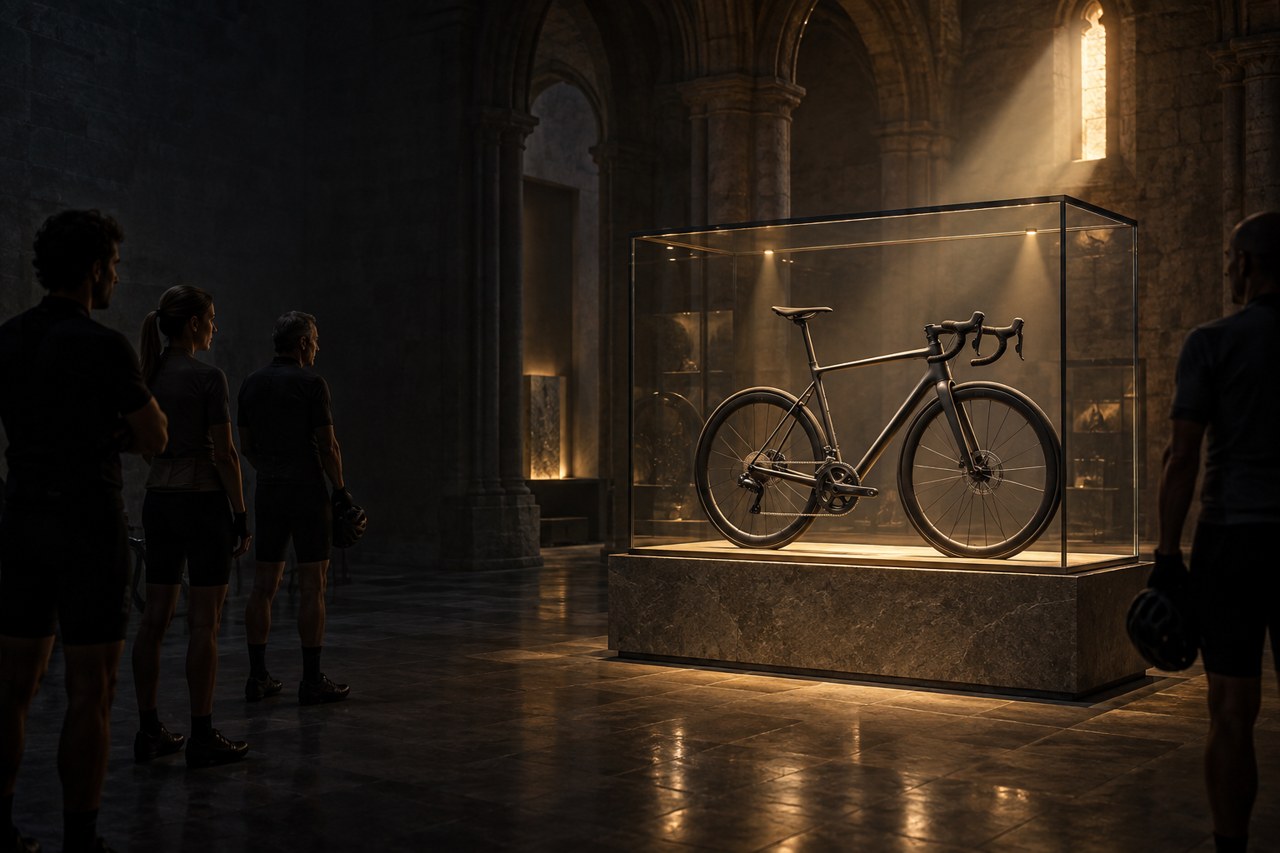
The Middle Ages are not as far behind us as we might think. At least, not in the minds of many cyclists.
Back then, people worshipped relics. A fragment of wood, a piece of cloth or a bone could become an object of immense value—not so much because of what it was materially, but because of what it represented. Its value came primarily from the name, the history and the authority with which it was associated.
Today, the objects of our devotion have changed. The underlying mechanism has not always changed with them.
There are the devotees of short, compact bikes, simply because they have seen them ridden by professionals—without asking what process led those riders to such solutions, or what athletic, biomechanical and technical adaptations lie behind them.
There are the believers in aerodynamics, ready to obsess over every detail while almost never having any personal basis for comparison. Instead, they place their trust in figures, percentages and claims of watts saved, presented by those who—quite legitimately—also have those solutions to sell.
And then there are the worshippers of lightness. For a few years, every gram seemed to have lost much of its importance. Today, weight is once again at the heart of the narrative, and suddenly a handful of grams saved appears capable of transforming a bicycle.
Trends change. Faith adapts.
And then there are the most devoted followers of the major brands.
A few days ago, I happened to watch several people gathered around a bicycle made by a well-known American brand. Their comments were almost unanimous: “Beautiful.” “Absolutely stunning.” “Now that’s a proper bike.”
It was not an unattractive bicycle. But its colour scheme was fairly ordinary, its components were far from exclusive, and there was no immediately visible detail that could explain such unanimous enthusiasm.
It was not even that brand’s top-of-the-range model.
More importantly, many of the qualities that can make a bicycle genuinely good—its geometry, construction method, behaviour on the road, weight distribution and comfort—cannot be assessed simply by looking at it for a few seconds.
And yet the verdict had already been delivered. Probably because those people were not merely looking at the bicycle. They had recognised the brand.
The logo had already told them everything they were supposed to see: performance, technology, exclusivity, speed, prestige. It had anticipated their judgement and, in a sense, looked at the bicycle on their behalf.
This is where the comparison with a relic returns. The object is no longer judged solely for what it is. Part of its value comes from the authority of the name with which it is associated.
And this, perhaps, is the point at which marketing stops informing us and begins to resemble a religion.
It tells you that a bicycle is more aerodynamic. That it is faster. That it is more efficient. That the latest solution represents progress over the one that came before it.
It may even show you a number. But consumers rarely ask under what conditions that number was obtained, compared with what, with which rider, at what speed and—most importantly—how much that advantage will genuinely change the way they ride.
There is no longer any need to understand it fully. It is enough to believe.
And perhaps this is the most curious thing of all: we have access to more data, more measurements and more technology than any previous generation of cyclists.
And yet we continually risk using them to do the oldest thing in the world.
To put our faith in something.


