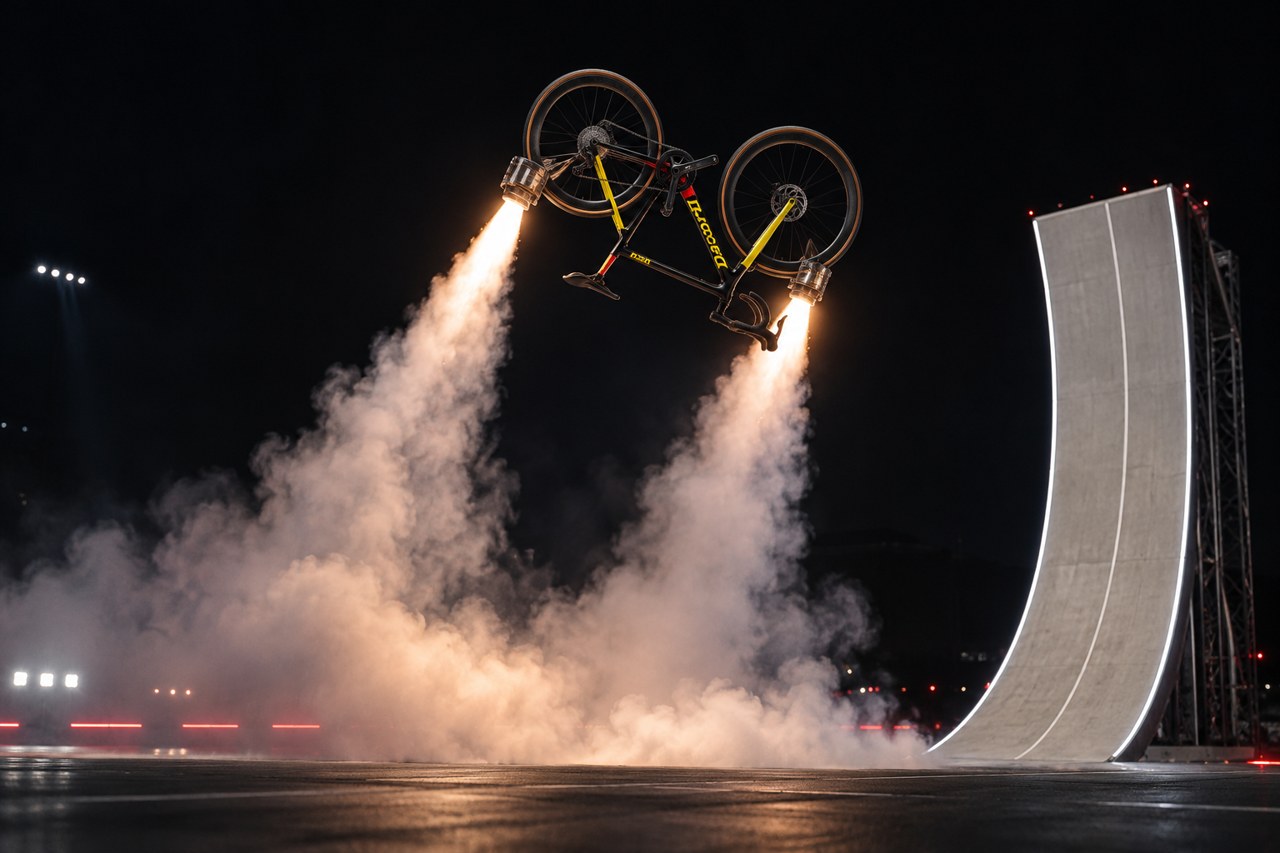
No, it’s not true. But we could have told you it was.
Tesla has unveiled a Roadster capable of driving upside down and performing aerial stunts. Fantastic. A car that can drive upside down. And what’s the point? Absolutely none. But that hardly matters, because the real goal isn’t to solve a problem or meet a need. The goal is to amaze, grab headlines, rack up millions of views, and convince the world that we’re witnessing yet another revolution. A car first announced in 2017, which still hasn’t reached the market almost ten years later, is suddenly making headlines again because it can do something completely pointless. It’s the triumph of marketing over substance.
Welcome to the age of technological hype.
Giant multinational corporations spend fortunes convincing us that every new gimmick they come up with is destined to change the future of humanity. It doesn’t matter whether it’s useful, necessary, or even available to buy. As long as it’s spectacular. Consumers aren’t supposed to think. They’re supposed to cheer.
Remember those Amazon stores where you could walk in, pick up whatever you wanted, and leave without going through a checkout? An artificial intelligence revolution, they told us. Cameras, algorithms, complete automation. Then it emerged that more than a thousand people in India were working behind the scenes of this technological marvel, reviewing footage to check what customers were buying. According to an investigation, around 70% of purchases in 2022 required human review. Behind the curtain were real people doing the work the public had been led to believe was being done by machines.
And Volkswagen? For years, it sold us the fairy tale of Clean Diesel: a modern, environmentally friendly diesel engine. Then, in 2015, it emerged that millions of cars had been fitted with software designed to detect when they were undergoing emissions tests. So much for the green revolution. They had built a system designed to cheat the tests. And the world believed the story for years.
In 2023, Google unveiled Gemini, its new artificial intelligence system, with a video that left the world speechless. A person showed objects, made drawings, spoke to the computer, and received instant responses, as though having a conversation with another human being. Except that, after the presentation, it emerged that the conversation had never actually happened the way it was shown. The video had been carefully edited to create the illusion of a live voice conversation. Once again, the advertising was moving much faster than the technology itself.
But stopping at advertising would be a mistake.
Because when a company becomes powerful enough to influence what millions of people think, it’s fair to ask just how much influence it can exert over those who govern us. Some of these corporations generate more annual revenue than the yearly budgets of many countries, have enormous market valuations, and command financial resources that allow them to negotiate directly with governments and international institutions. Two powerful forces sitting at the same table, negotiating agreements and making decisions that ultimately affect the lives of millions of people. Corporations may not have the same formal authority as governments, but they certainly have enough economic power to influence their decisions.
Wars, international tensions, and economic crises are not born exclusively in the boardrooms of giant multinational corporations. But it would be naive to believe that economic interests play no role in government decisions. Energy, raw materials, technology, markets, military supplies: behind many conflicts and international tensions lies a complex web of political decisions and industrial interests. Corporations don’t formally declare wars, but some can profit from certain decisions, support them, or exert pressure on the policies surrounding them. The line between economic power and political power is becoming increasingly difficult to distinguish.
Craftsmanship represents the exact opposite of this mindset.
A handcrafted object is an expression of the culture, intelligence, skill, and history of the people who make it. Buying a handcrafted product from Japan, Iran, Russia, or the United States doesn’t mean supporting that country’s government. It means recognising the value of its people’s work. It’s an exchange of knowledge, traditions, and mutual respect. A relationship that has existed for centuries, long before multinational corporations, and one that doesn’t require anyone to conquer or destroy someone else in order to thrive.
An Italian craftsman can admire the work of a Russian craftsman even when their governments are enemies. He can learn from a Japanese craftsman, collaborate with an American, and share his techniques with a French one. Nobody has to lose for someone else to succeed. That’s the difference between an economy built on the concentration of power and a culture built on exchange.
We build bicycles. They don’t fly, and they don’t ride upside down. But they’re the result of knowledge, materials, and skills that cross borders. And we’ll continue to admire the work of anyone who knows how to build a beautiful bicycle, wherever they are and whatever their nationality.
When you ride a handcrafted bicycle, you carry with you a small piece of a people’s culture, knowledge, and craftsmanship. And when you ride a handcrafted bicycle, in your own small way, you become an ambassador for peace in the world.